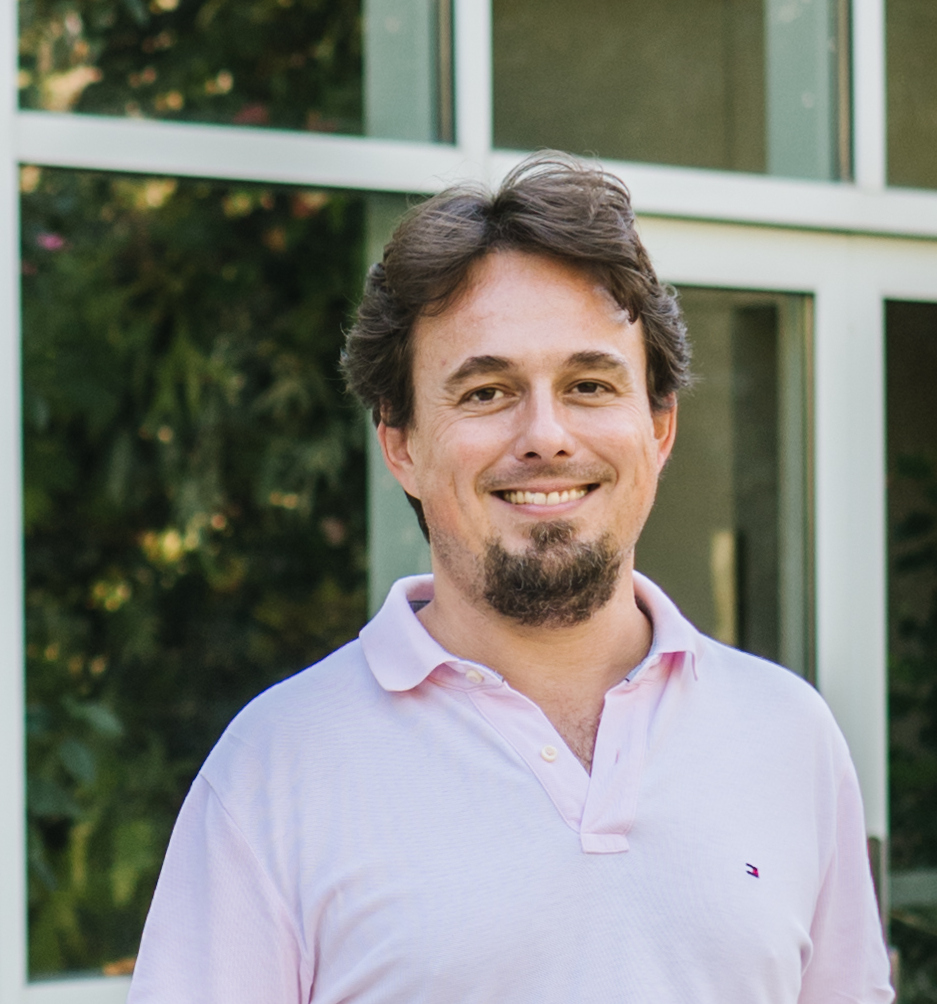
I am an Assistant Professor in the Electrical and Computer Engineering
Department at the University of Utah.
I am also a USTAR faculty
member at the Scientific Computing
and Imaging Institute and a member of the Utah Center for Neuroimage Analysis and the Center for Advanced Microscopy. My research interests are in the
general areas of image processing and pattern recognition. More
specifically we study image neighborhoods and
context for image registration and segmentation; and variational
methods and level-sets for volume restoration, reconstruction and
segmentation. Over the last five years, the main driving application of
my research has been neural circuit reconstruction (connectomics) from
large-scale electron and confocal microscopy image datasets. This
application poses challenges in image registration, pattern recognition
and 3D segmentation, which are very well aligned with my research
interests.
Image
registration: My research group has developed algorithms for
assembling 3D volumes from hundreds of thousands of 2D images of serial
sections. In electron microscopy, our approach uses the well-known
shift property of the Fourier transform for a computationally feasible
solution to correcting distortions between sections due to the cutting
process as well as the imaging optics. For confocal microscopy of
neurons, we have recently developed a novel algorithm that combines
axon tracing and a landmark based alignment approach that is well
suited to the sparse nature of these images. These tools are combined
in our NCR Toolset,
which is freely available along with an easy to use graphical
interface. Our main related publications in this area are:
J.R. Anderson, B.W. Jones, J-H Yang, M.V. Shaw, C.B.
Watt, P. Koshevoy,
J. Spaltenstein, E. Jurrus, Kannan U V, R. Whitaker, D. Mastronarde ,
T. Tasdizen, R.E. Marc. "A
Computational
Framework for Ultrastructural Mapping of Neural Circuitry" PLoS
Biology, March, vol. 7, no. 3, pp. e74, 2009.
Pattern
Recognition: Electron microscopy images of neural tissue are
typically hard to segment due to their properties. The staining used in
electron microscopy is non-selective, i.e. it highlights all cellular
and intracellular membranes present in the tissue sample. Therefore, a
successful segmentation of cells first requires the differentiation of
cellular membranes from intracellular membranes, which look similar at
the local scale but are differentiable using non-local contextual cues.
We have developed a series artificial neural network classifier that
uses non-local context to provide as good or better accuracy compared
to other approaches to the cell membrane detection problem. A
significant advantage of our method over previous approaches is the
sequential stage design that allows for efficient training. See the
following papers and Liz
Jurrus' webpage for more details.
S. M. Seyedhosseini, R.
Kumar, E. Jurrus, R. Guily, M. Ellisman, H. Pfister and T. Tasdizen,
”Detection of Neuron Membranes in Electron Microscopy Images
using Multi-scale Context and Radon-like Features,” accepted to
MICCAI
2011.
Also, for problems ranging from filtering to
recognition, the conventional wisdom in image processing is to use a
filter bank hand designed to match the problem at hand. However,
filters are functions of image neighborhoods and evidence suggests they
can be used directly as a feature representation. For instance, we have
used image neighborhoods directly to classify brain tissues in magnetic
resonance images and to segment general textured images. Unfortunately,
a problem with representing context from large areas using image
neighborhoods is the curse of dimensionality. We have used principal
component analysis of image neighborhoods to develop a novel version of
the non-local means image restoration algorithm that outperforms the
original algorithm. Similarly, for cell membrane detection, we are
currently utilizing a multi-scale image neighborhood approach to
develop a method that will surpass the accuracy of state-of-the-art
approaches.
S. Gerber, T.
Tasdizen, T. Fletcher, S. Joshi and R. T. Whitaker, Manifold
Modeling
for Brain Population Analysis, Medical
Image Analysis,
Volume 14, Issue 5, Special Issue on the 12th International Conference
on Medical Image Computing and Computer Assisted Intervention (MICCAI),
October 2010, Pages 643-653. Best paper of the
special issue award.
3D segmentation:
Even state-of-the art approaches can’t provide perfect cell
membrane detection results. Gaps may exist between adjacent cells or a
single cell can have false positive membranes inside, resulting in
over-segmentation. Combining the detected membranes with shape-based
regularization can further reduce these errors. We developed a novel
three-dimensional surface processing method that is based on
optimization of energy function defined on the field of surface normal
vectors. Our approach couples a partial differential equation (PDE)
that minimizes the surface normal energy and another PDE that links the
surface to the changes in the surface normal vectors resulting from the
first PDE. We have applied this approach to smoothing and
enhancement of geometrical models, and reconstruction of objects from
laser range finder data. While our original methods were developed for
models represented as level-set functions, other researchers have
extended our methods to surface meshes. Some related publications are:
T. Tasdizen, R.
T. Whitaker, Paul Burchard and Stanley
Osher, “Geometric Surface
Processing via Normal Maps,” ACM Transactions on Graphics,
Vol. 22, Num. 4, Pages1012-1033, October 2003.
Teaching
Machine Learning CS 5350/6350, Spring 2006
Digital
Image Processing, ECE 6962, Fall 2008, Fall 2010
Engineering
Probability and Statistics, ECE 3530, Spring 2009, Spring 2010, Spring
2011
Estimation
Theory, ECE 6540, Fall 2009, Fall 2011
Contact Information
Best way to get in touch with me is via email.
Office WEB 3887
Phone (801) 581-3539
Fax (801)
585-6513
Mail
Scientific Computing and Imaging Institute
University of
Utah
72 S. Central
Campus Drive, 3750 WEB
Salt Lake
City, 84112, USA