Instructor: Dr. Bei Wang Phillips (beiwang AT sci.utah.edu)
Lectures: Tuesdays, Thursdays, 3:40 p.m. - 5:00 p.m, MEB 2325
Office Hours:
Tuesdays 3:00 p.m. - 3:30 p.m WEB 4608, or by appointment (beiwang AT sci.utah.edu) via Zoom.
University of Utah Course Catalog, Spring 2026.
Course Description:
Computational topology lies at the intersection of algebraic topology and computer science and serves as the theoretical foundation for Topological Data Analysis (TDA). TDA is an emerging area within exploratory data analysis and data mining that has attracted growing interest and achieved notable successes across an expanding research community. The application of topological techniques to large-scale and complex data has opened new opportunities in science, engineering, and business intelligence.
The goal of TDA is to understand complex datasets, where complexity arises not only from data scale but also from the richness and structure of underlying features. The objective of this course is to familiarize students with modern methods in computational topology and TDA from theoretical, algorithmic, and applied perspectives.
Successful completion of the course will prepare students to become data practitioners capable of applying TDA pipelines to a wide range of real-world datasets in areas such as materials science, biomedicine, and business intelligence. Students will also be positioned to pursue new research directions in computational topology and TDA, as well as to integrate advanced topological techniques with other areas of data science, including data mining, machine learning, computer graphics, geometric modeling, mesh generation, and data visualization.
For Spring 2026, the course will additionally cover recent advances at the intersection of topology and machine learning, with particular emphasis on topological deep learning.
Prerequisites: There are no formal prerequisites for this class. Students will be expected to have basic knowledge of data structures and algorithmic techniques.
The targeted audience for the class includes PhD students, master students and very-motivated upper level undergraduate students, in particular, from Computer Science and Mathematics.
The students are not required to be majoring in Computer Science or Mathematics, but it is preferable that the students have some background in algorithms and/or other data science related courses.
If you are not sure whether you are qualified to take this class, please email the instructor.
Suggested Topics:
The course materials are organized under three mutually inclusive modules:
- Topological Foundations and Pipeline (FP)
- Topology Meets Machine Learning and Statistics (ML)
- TDA in Data Science (DS)
The course may cover (but is not limited to) the following topics:
- Basic concepts (graphs, connected components, topological space, manifold, point cloud samples)
- Combinatorial structures on point cloud data (simplicial complexes)
- New techniques in dimension reduction (circular coordinates, etc.)
- Clustering (topology-based data partition, classification)
- Homology and persistent homology
- Topological signatures for classification
- Structural inference and reconstruction from data
- Topological algorithms for massive data
- Multivariate and high-dimensional data analysis
- Topological data analysis for visualization (vector fields, topological structures)
- Practical applications of TDA
- Topological deep learning
Assignments:
Students will complete both individual and group assignments, with the primary component being a course project. A list of suggested project topics will be provided, and students are encouraged to propose their own project ideas in consultation with the instructor. For larger projects, students may work in small groups of up to two members.
Class Information:
Communication:
Most communication is handled through the Canvas system. Additionally, please feel free to email the instructor for questions.
When class material questions are sent to the instructor, we may isolate the question and post the response to Canvas (so that all can learn from both the question and the answer).
Required Textbook:
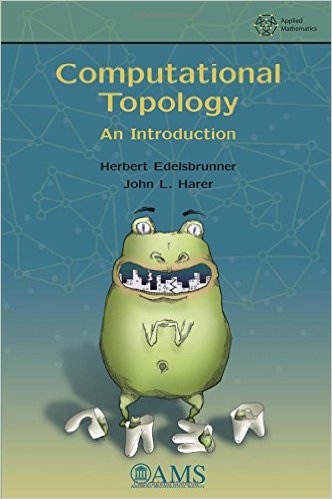
Computational Topology: An Introduction by Herbert Edelsbrunner and John Harer
Recommended Reading:
Disability Notice
The University of Utah seeks to provide equal access to its
programs, services and activities for people with disabilities.
If
you will need accommodations in the class, reasonable prior notice
needs
to be given to the Center for Disability Services, 162 Olpin Union
Building,
581-5020 (V/TDD). CDS will work with you and the instructor to
make
arrangements for accommodations.
All written information in this course can be made available in
alternative
format with prior notification to the Center for Disability Services.
|

